
The Morning Call
11/4/26
The
Market
Technical
Tuesday in the
charts.
Capitulation?
Tuesday in the
technical stats.
https://www.barchart.com/stocks/momentum
https://www.barchart.com/stocks/market-performance
https://www.barchart.com/stocks/sectors/rankings
https://www.barchart.com/stocks/signals/new-recommendations
The AI boom is
hiding something very ugly.
Debt limits are
real and binding.
Wall Street’s most
hated stocks are faring better than its favorites.
Wednesday morning
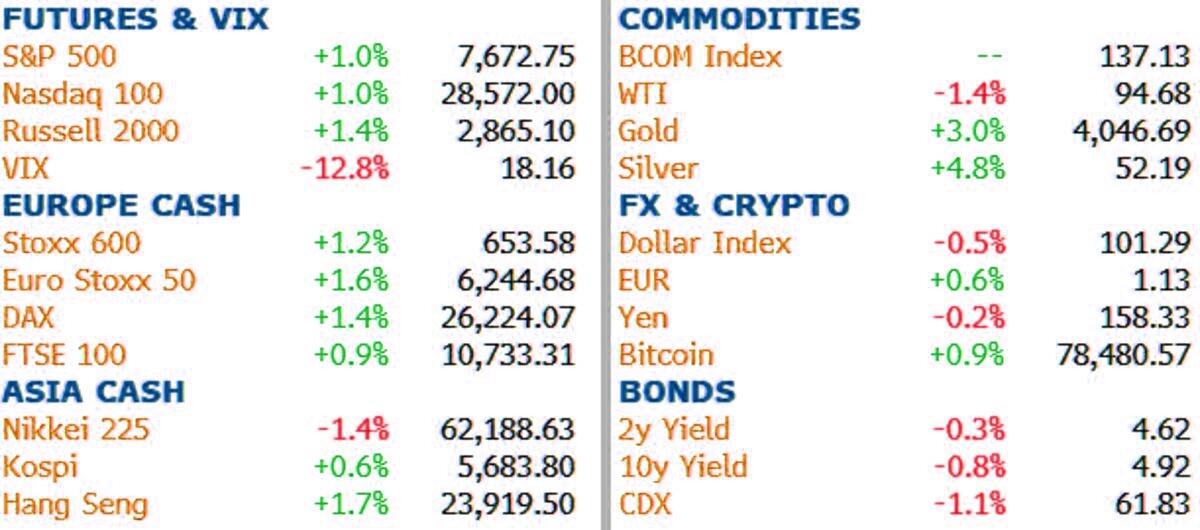
setup; US futures are higher as dip buyers turned an overnight "blue
tsunami" puke into a broad rally: Democrats swept both chambers of
Congress, initially sending Nasdaq 100 futures down as much as 2.4% on fears of
tighter AI regulation and a Texas data center freeze, before President Trump's
conciliatory tone (he said Democrats did "a good job" and that he
can work with them), AMD's blowout guide and the monetization of a pile of
election hedges flipped futures solidly green; as a result the dollar is
heading for its worst day since early September while gold blasts back
above $4,000. As of 8:15am ET, S&P futures are 0.9% higher at 7,665 while
Nasdaq futures are down 0.2%, Russell 2000 futures jump 1.3% and Dow futures
are up roughly 1.7%, or about 870 points, as VIX tumbles 12.8% to 18.16. Stocks
rose on Tuesday ahead of the vote, with the S&P 500 snapping a three-day
losing streak and semis rebounding 2.6% after an 11.6% three-session plunge. In
premarket trading, the Mag 7 is mostly higher led by Amazon, while Musk's Tesla
and SpaceX bear the brunt of the blue wave; AMD (+6.3%), Super Micro (+9.2%)
and Arista (+10.9%) lead chips higher after earnings, confirming
our article from last night, while solar names soar and defense stocks
slide. The day's driver is politics (finally): Democrats flipped Senate
seats in Texas, Ohio, Kansas, South Carolina, North Carolina, Iowa and Maine,
won the governorships of Texas, Ohio and Georgia, and are on track for at least
54 Senate seats; as we explained overnight, Texas
turned blue and futures turned green as the market concluded the AI fallout
would mean regulation rather than cessation. Treasuries are bid with yields
3-5bps lower and the 10Y at about 4.915% as divided government curbs the fiscal
outlook and the curve flattens ahead of the 8:30am refunding announcement. The
Bloomberg dollar index slides 0.5% to the lowest since Sept. 30, with the kiwi
leading G10 gains and EUR/USD up 0.6%. In commodities, WTI is down about 1%
near $95 as Trump played down the prospect of imminent strikes on Iran, while gold
jumps 3% and silver surges almost 5%; copper is flat. Bitcoin rises about 1% to
$78,480. US economic data slate includes October ADP employment change
(8:15am), September trade balance (8:30am), October final S&P Global
services and composite PMIs (9:45am) and ISM services (10am). There are no Fed
speakers scheduled. The Treasury publishes its quarterly refunding announcement
at 8:30am and sells $75 billion of 17-week bills at 11:30am.
Fundamental
Headlines
The
Economy
US
Weekly mortgage
applications declined 1.2% while purchase applications were down 2.0%.
Month to date
retail chain store sales rose 10.4% versus + 9.3% in the prior week.
September job
openings (JOLTS) totaled 7.52 million versus forecasts of 7.0 million.
https://bonddad.blogspot.com/2026/11/september-jolts-report-another.html
September factory
orders were up 1.8% versus predictions of +1.2%; ex transportation, they were
up 1.3% versus +0.9%.
The October ADP
employment report showed job increases of 86,000 versus consensus of 69,000.
International
The October
Chinese services PMI was 50.8 versus expectations of 51.5; the composite PMI was
52.0 versus 52.2; the October German services PMI was 52.5 versus 51.7; the
composite PMI was 53.4 versus 52.8; the October EU services PMI was 51.4 versus
51.7; the composite PMI was 51.7 versus 51.9; the October UK services PMI was
51.4 versus 51.7; the composite PMI was 52.9 versus 53.1.
The October EU CPI
was up 0.4% versus estimates of +0.3%.
Other
September median household income.
https://politicalcalculations.blogspot.com/2026/11/median-household-income-in-september.html
Data center
construction sends shock wave through the industrial economy; costs experience
a second wave of inflation.
Monetary
Policy
How high would the Fed Funds rate need to be
to bring inflation back to 2%?
Fiscal
Policy
Bankrupting America. (To be fair, it is not
just Trump. It is the entire ruling class.)
Inflation
The inflation election.
What
millions of data points reveal about inflation.
AI
AI’s third big bang is here.
https://www.riskhedge.com/outplacement/ai-is-third-big-bang-is-here
The Election
Wall Street reaction.
The
Financial System
More proof that the commercial real estate
market is cracking.
Investing
Finding growth without
froth.
https://www.advisorperspectives.com/commentaries/2026/11/03/case-garp-finding-growth-without-froth
Short term Market
moves won’t give us the answers to AI.
https://behaviouralinvestment.com/2026/11/03/short-term-market-moves-wont-give-us-the-answers-on-ai/
Central banks accelerated
gold buying in third quarter.
Total return
forecasts for major asset classes.
https://www.capitalspectator.com/total-return-forecasts-major-asset-classes-3-november-2026/
Was that the top?
https://talkmarkets.com/article/was-that-the-top-analyzing-techs-2026-correction
Downside
Breakdowns (Range Support Break)
- Short-Term
Returns: Breaking below the lower boundary of an extended trading range or
key moving average (like the 200-day moving average) carries a weaker
immediate profile. Historical instances of breaking below established
support thresholds show an average short-term loss (e.g., -0.29% over
the next month) with lower win rates (~57% positive). [1]
- Continuation
Risk: When downside breaks coincide with macro shocks or loss of major
structural support (such as the 200-day moving average), historical
precedents show that declines can extend significantly (ranging from 10%
to 25% or more in broader bear or correction phases), unless a fast policy
or geopolitical catalyst triggers a mean-reverting bounce. [1, 2]
- Mean
Reversion: Severe single-day or sharp panic breakdowns below a range often
trigger short-term oversold bounces or mean-reverting rallies within a few
weeks, though these sharp snaps do not always dictate the longer-term
primary trend. [1]
News on Stocks in Our Portfolios
What
I am reading today
Wednesday
morning humor.
This
is a choice? I try to avoid politics; but this crystalizes my sentiment.
https://reason.com/2026/10/31/for-libertarians-election-day-is-the-cruelest-day-of-the-year/
Visit Investing
for Survival’s website (http://investingforsurvival.com/home)
to learn more about our Investment Strategy, Prices Disciplines and Subscriber
Service.

No comments:
Post a Comment